
Enterprise Agentic AI: Foundation Before Agents
Every boardroom conversation in 2026 seems to circle back to one word: agents. Autonomous systems that don’t just answer questions but plan, decide, and act on their own. The excitement is justified and so is the caution. Gartner expects 40% of enterprise applications to embed task-specific AI agents by the end of 2026, up from
Every boardroom conversation in 2026 seems to circle back to one word: agents. Autonomous systems that don’t just answer questions but plan, decide, and act on their own. The excitement is justified and so is the caution.
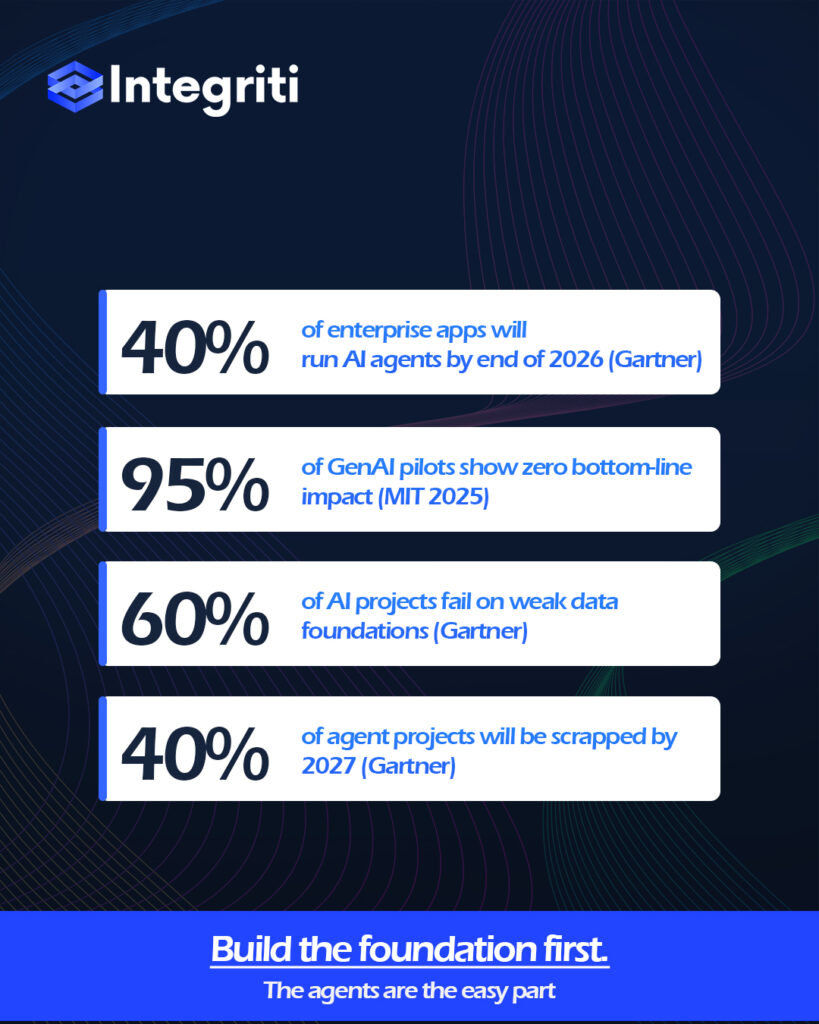
Gartner expects 40% of enterprise applications to embed task-specific AI agents by the end of 2026, up from less than 5% a year earlier. Yet the same analysts warn that more than 40% of agentic AI projects will be cancelled by the end of 2027, undone by escalating costs, unclear business value, and weak risk controls. Both numbers are true at once. The gap between them is where most organizations will either win or quietly waste their budgets.
The Uncomfortable Data
The most sobering signal comes from MIT. Its 2025 State of AI in Business report found that roughly 95% of enterprise generative-AI pilots delivered no measurable impact on the bottom line. The failures, researchers noted, were rarely about the model. They were about brittle workflows, missing feedback loops, and data that was never ready for production.
That last point is the quiet killer. Gartner predicts 60% of AI projects will be abandoned through 2026 because organizations lack AI-ready data — and 63% of organizations either lack the right data-management practices or are unsure whether they have them. Informatica’s 2025 CDO survey ranked data quality and readiness as the number-one obstacle to AI success.
The pattern is unmistakable: agents fail not because the intelligence is weak, but because the foundation beneath them is.
→ See how we assess data readiness before any agent goes live
Why Agents Amplify Your Weaknesses
A chatbot that retrieves a wrong answer is an inconvenience. An autonomous agent that acts on bad data — approving an invoice, adjusting inventory, escalating a case — turns that inconvenience into a business consequence. Autonomy raises the stakes of every flaw already living in your environment.
This is why “foundation before agents” isn’t a slogan it’s a sequence. Before deploying autonomous systems, three things have to be in place:
- Clean, governed, accessible data. McKinsey’s 2025 research found organizations reporting significant returns from AI were markedly more likely to have redesigned their end-to-end data workflows before choosing models.
- Clear ownership and guardrails. Gartner’s 2026 Hype Cycle flagged agentic-AI governance, security, and cost discipline as defining concerns emerging early — not afterthoughts.
- A defined outcome. The winning 5% in MIT’s study consistently started with a measurable business problem, not a flashy demo.
Start Where the Foundation Is Strongest
The encouraging news is that adoption intent is real, and disciplined teams are pulling ahead.
Gartner’s 2026 CIO survey found only 17% of organizations have deployed AI agents so far, but more than 60% expect to within two years the most aggressive adoption curve of any emerging technology measured.
The organizations in that leading 17% rarely started with the most glamorous use case. They started where their data was cleanest, their workflows best understood, and their success metrics clearest often in the back office, where MIT found returns were highest. They treated agents as accountable systems with defined responsibilities, not as magic layered on top of legacy chaos.
→ Talk to our team about a governed agentic-AI roadmap
The Takeaway
Agentic AI will reshape enterprise operations over the next decade — Gartner’s best-case scenario has it driving roughly 30% of enterprise application software revenue, more than $450 billion, by 2035. But that future belongs to the companies that resist the temptation to rush.
The question worth asking in your next planning session isn’t
“which agent should we build first?”
It’s “is our foundation ready to be trusted with autonomy?”
Get that answer right, and the agents will follow. Get it wrong, and you risk joining the 40% of projects quietly shut down by 2027.
Build the foundation first. The agents are the easy part.