Legacy application modernization services that keep your business running
We rebuild the old systems your business depends on, on a modern, supported stack, while your team keeps working. Then we stay for support and the next phase.
- 12-year-old claims platform rebuilt
- Same team for 3+ years
- In business since 2016
- Offices in New York and Toronto
When the system you can't replace is the one holding you back
Most companies don't choose to run on a 10-year-old application. It just keeps working, until it doesn't. If any of this sounds familiar, you're in the right place.
- Every release breaks something, so changes wait months.
- The framework is out of support, and your auditors have noticed.
- The few people who understand the old code are leaving.
- The system can't connect to modern APIs, cloud services or AI.
- You've heard rewrite horror stories and can't afford one of your own.
What we modernize
The workflows, data and rules stay. The technology underneath them changes.
Aging web applications
PHP, older .NETASP.NET Core and C#Rebuilt with the workflows your users rely on.
Unsupported .NET versions
.NET Framework, .NET 7Current .NETUpgrades without changing what users see.
.NET developmentLegacy databases
Firebird and other aging databasesMicrosoft SQL ServerData checked against the old system before cutover.
On-premise hosting
Servers you maintainAWS or AzureApplications moved to the cloud, with monitoring from day one.
Cloud migrationLegacy SAP integrations
Custom and SAP-to-SAP feedsRebuilt, logged integrationsRebuilt so payroll stays accurate.
SAP HCM integrationsNot sure where your system fits?
The assessment maps your application, data and hosting, and compares upgrading, re-platforming and rebuilding side by side.
See the assessment
How we modernize without stopping the business
Each piece is rebuilt and tested on its own, and nothing switches over until the results match.
Assess
We review your application, code, data and hosting, and walk through key workflows with your users. You get options and a phased plan.
Plan in phases
Screens, background jobs and data move in separate streams, so each is tested on its own.
Rebuild with your team
Two-week sprints, code reviews with your developers and dedicated QA automation engineers on every sprint.
Run in parallel, then cut over
Old and new systems run side by side until the results match. Cutover support is part of the plan.
Support and extend
We stay for production support, new modules and upgrades.
Your operations keep running through every step
A claims platform rebuilt, then extended for 3+ years
A workers' compensation pharmacy claims administrator ran its business on a 12-year-old PHP system. We rebuilt it in .NET and SQL Server, with a month of parallel running before cutover.
- 2 to 5 min
- claim ingestion, down from about 1.5 hours
- 30 min
- allocation, down from about a week
- 3+ years
- the same team still adds modules, upgrades and AI features
Drag to compare. Illustration with sample data.
Also delivered: a finance data platform on Microsoft Azure for a Canadian investment fund, with a 25% gain in operational efficiency.
Why teams choose us for modernization
- A team that stays
- Our claims client has worked with the same team for more than 3 years.
- Senior attention
- Your first call is with our CEO or CTO, and senior engineers lead the work.
- Quality built in
- Dedicated QA automation engineers test every sprint.
- Your working hours
- Our engineers work your schedule: North American engineers onsite, hybrid or remote, and a global delivery team working 8 am to 5 pm ET.
- Straight answers
- If upgrading or buying beats rebuilding, we'll say so.
Start with a modernization assessment
In about 2 to 3 weeks, we review your application and hand you a written plan, so you can decide with real options, timelines and costs in front of you. Fixed scope and fixed fee, agreed before we start and credited toward the full build.
- Your options compared: upgrade, re-platform, rebuild or replace
- A phased approach, with parallel running before cutover
- The team you would need, and how it works with yours
- A timeline for each phase
- A budget range for each option
Not ready to talk? Score your system first
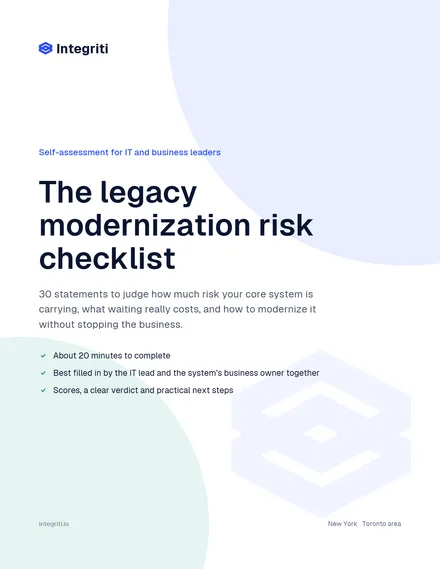
The legacy modernization risk checklist turns a vague worry into a clear verdict. Fill it in with your system's business owner.
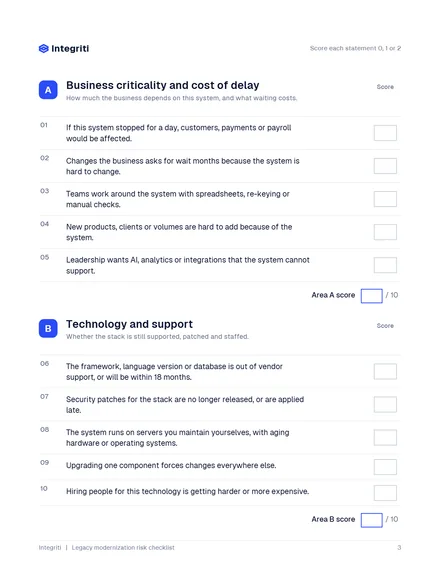
- 30 statements across six risk areas, about 20 minutes
- A score that tells you whether to act now, plan or wait
- How to choose between upgrading, re-platforming, rebuilding and replacing
Legacy application modernization FAQ
Straight answers to the questions we hear most.
What is legacy application modernization?
It means moving a business-critical application off an outdated technology stack onto a modern, supported one, while keeping the workflows, data and rules the business depends on. It can mean upgrading, moving to the cloud or rebuilding.
Should we rebuild, re-platform or just upgrade?
It depends on how healthy the code is, how well the stack is supported and what the business needs next. Upgrading costs least when the code is sound. Rebuilding makes sense when every change is risky. The assessment compares the options side by side.
How long does modernization take?
It depends on size and complexity. Our claims platform rebuild was planned over 12 months, including a month of end-to-end testing and a month of parallel running. Upgrades, such as .NET 7 to .NET 10, take far less time. You get a timeline after the assessment.
How do you migrate data without losing anything?
Data migration is its own stream with its own tests. We check migrated data against the old system, then check it again during parallel running before cutover.
Will our users need retraining?
Usually very little. We keep the workflows your users rely on and improve screens only where it helps.
Can you work alongside our in-house developers?
Yes. On the claims rebuild, the client's team owned product decisions and joined our code reviews.
Which technologies do you modernize to?
Most often ASP.NET Core and C# with Microsoft SQL Server, hosted on AWS or Azure. We also build in React, Next.js, Node.js and Python where they fit.
What does modernization cost?
It depends on scope. The assessment gives you a budget range for each option before you commit to a build.
Tell us about the system you can't afford to break
In a 30-minute call with our CEO or CTO, we'll talk through your system, your risks and what a phased plan could look like.
 Kamran AzamCEO and co-founder
 Omer HusainCTO and co-founder